Tuesday, July 16, 2013

La Grande Boucle! (Otherwise known as the Tour de France)

This past Saturday Lyon was visited by the Tour de France, commonly referred to here as La Grande Boucle. It had been 10 years since the Tour last made a stop here, and this time marked its 15th passage to Lyon since the first Tour in 1903. This year actually marked the 100th Tour de France, which they cleverly put in to their logo using the "e" in France to mark le 100e which is 100th. You might be wondering how it's the 100th Tour given that it started in 1903 and it is currently 2013. I certainly was! The reason is that there was no Tour (understandably) during the world wars.


Saturday was the 14th stage out of 21 and it was a pretty toasty day for anyone spending the day outside, let alone cycling at high speeds for several hours. The day started out for the competitors in Saint-Pourçain-sur-Sioule nearly 200km away from Lyon and arrived here just past 4:30pm local time. 


We'd been waiting for about an hour and a half prior to that to ensure a good vantage point and to catch the passing of the caravan. I really knew nothing about the caravan before Saturday but it's basically an entourage of sponsor cars honking, playing music and giving away free stuff. Everyone went wild running to grab whatever was thrown their way, it reminded me of the Pride parade! My favourite car/float had a stationary bicycle on top of it with a guy cycling in the air, it was pretty cool.


We set ourselves up in Croix Rousse on la Montée des Esses to have a decent chance at really seeing the competitors climb the hill instead of just whipping past us on a flat stretch (thanks to a hot tip from my mom courtesy of the cycling-savvy John Perreault). The map above shows the winding strip they had to ascend and James and I were nestled nicely in between the two loops at the bottom overlooking the first bend from the ridge above. We brought ourselves a little picnic and a couple beers and soaked up some soleil while waiting for the big moment.


Once the last of the caravan drove past you could feel the excitement start to grow, and then the sound of cheers floated up from further down the route. Before we knew it we saw the leader charging up the hill and I'm shouting "Allez! Allez!" with the rest of the crowd. The guy in second place wasn't too far behind, and then the peloton came up from behind. After another few minutes the pack from the back came through as well and just like that, we'd seen the Tour de France!


Because I knew my photos wouldn't do justice to what we were seeing, I took a video to capture the insanity. Allez-y!


Monday, July 15, 2013

Vieux Lyon

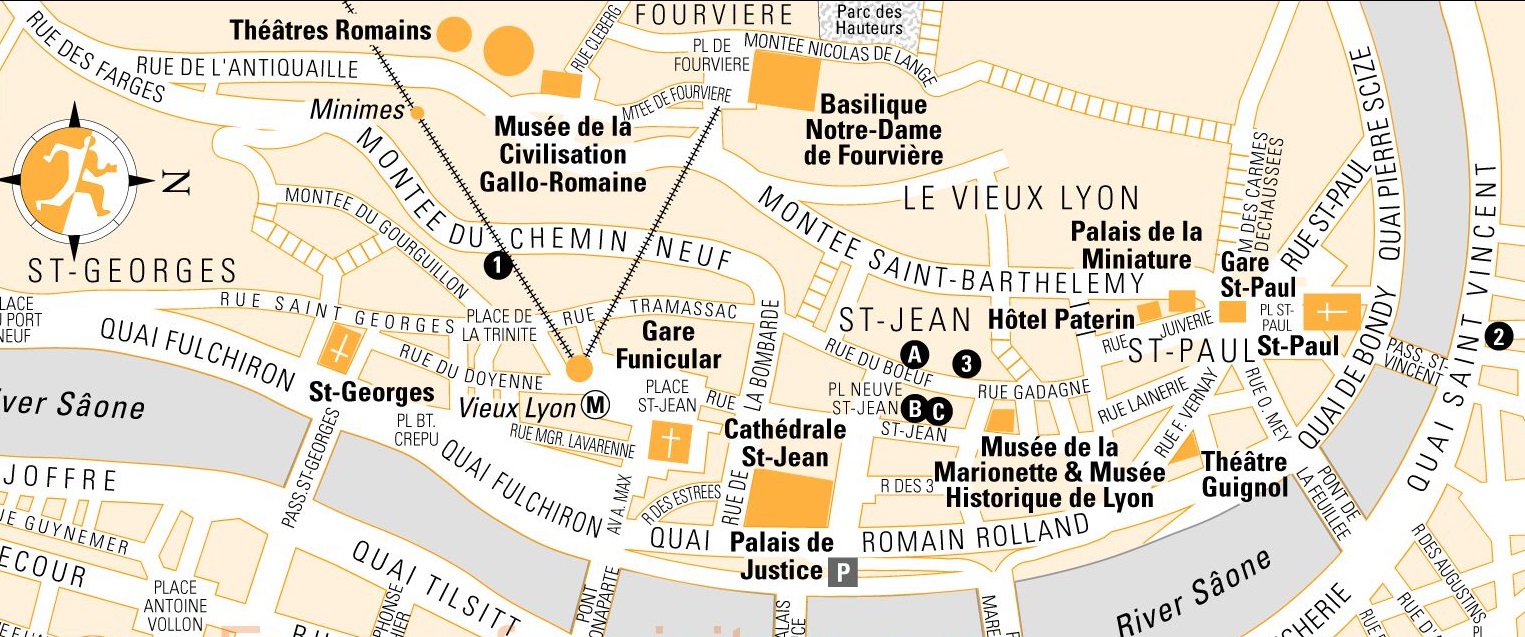
I wanted to devote an entire post to this part of Lyon because there's quite a lot to cover. Yesterday a Frenchwoman told me that Vieux Lyon is one of the largest preserved Renaissance districts in Europe, which I confirmed on Wikipedia (because if it's on the internet, it must be true). It is made up of three different areas: Saint-Georges, Saint-Jean and Saint-Paul. If you recall my earlier mentions of la Fourvière basilica, the old town is directly beneath it to the west of la Saône. The map below is facing west:


When I came here with Natalia in June 2008 we stayed in a hostel marked by the "1" on the map. It had impressive views but was also perfectly situated for us to check out Vieux Lyon, both the upper and the lower parts. Here's a shot spanning over the old town and the vast array of buildings and spectacular collection of chimneys, with the Saône and the Presqu'île in the background:


The two lines in the shape of a "V" on the map above are the funicular lines since it's quite a steep hill. These funiculars opened in the late 1800s, but there were others built in Croix-Rousse as well, one of which was converted into the metro line C in the late 1970s. The pictures below show what it looks like on the ground level coming out of the Vieux Lyon metro station:


You'll also notice some streets in the area are called montées since it is very much an ascent to get up them. There are also lots of stairs for pedestrians or piétons. You certainly get your exercise when walking around this part of town!


Meandering through the cobblestone streets you truly feel like you have gone back a few hundred years (minus the tourists) as some buildings date back to the 15th and 16th centuries. Another special treasure in this part of the city, as well as in Croix-Rousse, are the traboules. In a very truncated explanation, these are passageways constructed through buildings to allow for easier access to the river and the streets parallel to it, but you can learn a bit more about them here: http://en.wikipedia.org/wiki/Traboule

In general the architecture here is just really pleasing to look at. Many of the buildings are a pinky-orange colour and even if it's tourist-heavy area it's still enchanting to stroll around the streets full of terrasses (patios) for the endless selection of restaurants.


While the buildings in the lower part of the town are striking, there is far more ancient history to be found in the upper part near la Fourvière. Founded in 43 BC and named Lugdunum, it was the capital of Gaul and second in importance only to Rome for hundreds of years in the Roman Empire. (Mom and Dad - your expertise will be tested when you come to visit!)

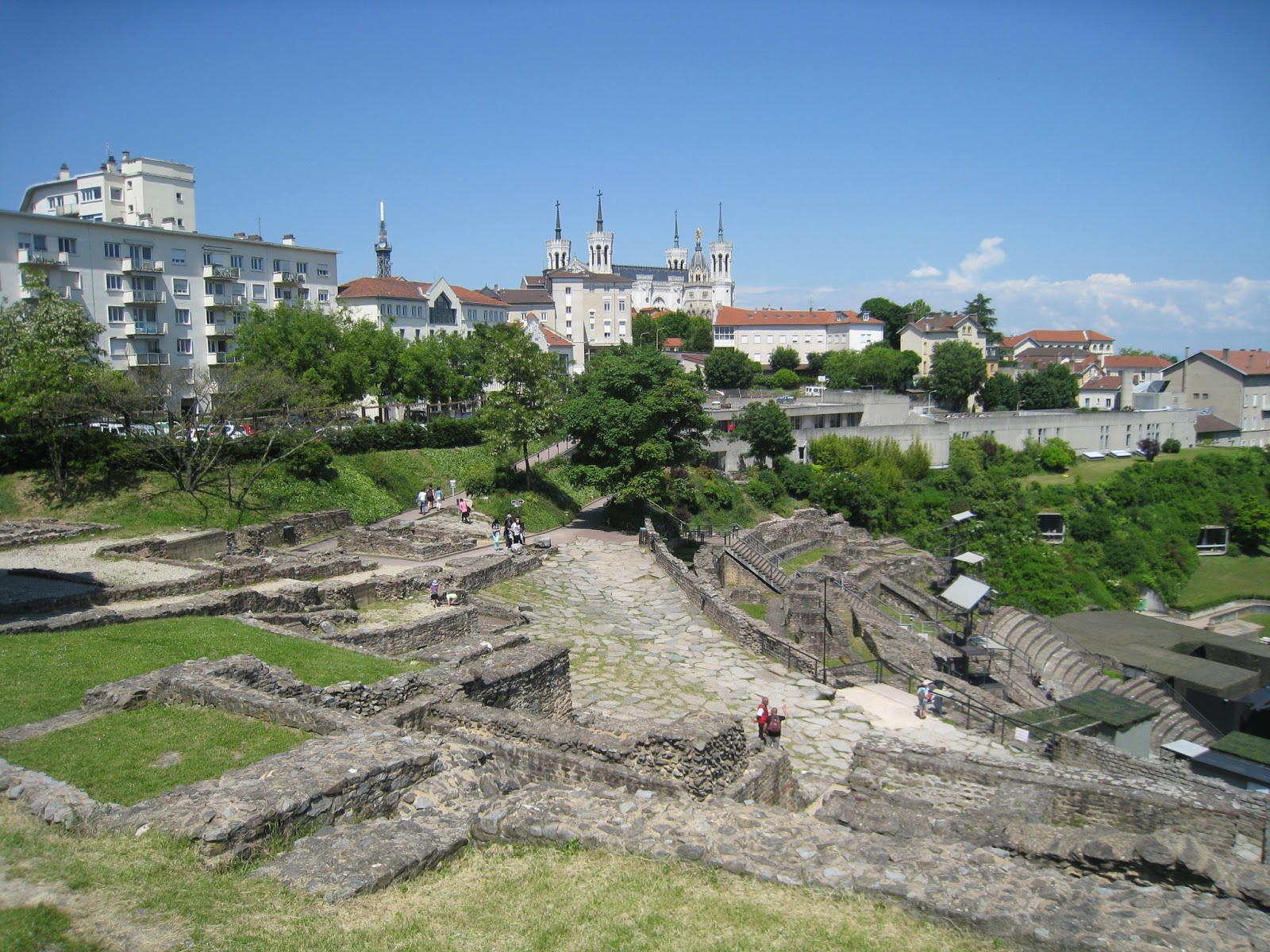
There is a museum nearby called Musée gallo-romain de Lyon-Fourvière which we have yet to check out but we have walked around the two outdoor Roman amphitheatres and surrounding ruins. Quite deservedly this area is a UNESCO World Heritage Site. Check out their site for Lyon here: http://whc.unesco.org/en/list/872. 


The last shot is of la Fourvière from the front. While you can see the church from many parts of downtown, you really have to go up to see it in person. It's such an icon for the city, one of the funiculars goes directly to it and it's free to enter both the basilica and the crypt. A must when visiting Lyon.

We were fortunate enough to watch a Rufus Wainwright concert in one of the amphitheatres last week, essentially the highlight of my life. It was part of Les Nuits de Fourvière, a summer festival held every June and July for over 60 years supporting the arts. I'd seen Rufus three times prior to this in Toronto, once doing a solo show and twice with a band. He was performing solo again and as usual it was phenomenal. For those of you who do not know Rufus' music, please get acquainted with it. It may not be for everyone, but he is superbly talented and most definitely worth a listen. 


He sang several songs in French and spoke in French as well which was great. Proudly I knew all but three songs that he sang during the two hours we were there (he has seven albums which I know by heart). The first unknown was written by his aunt Anna McGarrigle, "Excursion à Venise" and the second was by his late mother Kate McGarrigle, "Entre Lajeunesse et la sagesse". In a move guaranteed to engage the audience even more he sang a Serge Gainsbourg song as part of his encore, "Je suis venu te dire que je m'en vais". Luckily I found the clip of him singing it at our concert on YouTube! Oh internet, thank you. Here for your listening pleasure: http://www.youtube.com/watch?v=pKLyHhd5MjY

(Just to note - as one can imagine, sitting on ancient stones is not the most comfortable, so the festival provided everyone with a little plastic seat cushion, and at the end of the show everyone threw them up in he air and towards the stage in a gesture of appreciation amid applause and cheers.)

Aside from the highlight of his voice, the sunset was incredible and was actually paired with an immense lightning storm striking all over the city behind the stage to the east. It was truly breathtaking (literally - you could hear gasps from the audience during the songs because it was so intense). We barely had any actual rain come down, so it just added to the overall splendour of the show. It's going to be hard to top that performance...

Sunday, July 7, 2013

An introduction to Lyon

Prior to our June 1 arrival we had done a lot of research reading about the different areas of the city and learning about its extensive history. We bought ourselves three very helpful books: one about Lyon itself, one about the whole region of Rhone-Alpes, and one about living abroad in France. Most books in the France section are about Paris, and naturally they are targeted to travelers on holiday or backpackers, so we were very happy to discover these three.

Lyon, like Paris and Marseille, is split into arrondissements which are districts. We are currently living in the 8th, but right on the border of the 7th and the 3rd. Street names often change from one arrondissement to the next, even if it's the same road, so that was a little confusing when first learning the boundaries. For example, we live just off of Avenue des Frères Lumière on one side of a bridge, but on the other side it's called La Grande Rue de la Guillotière. Each arrondissement also comes with its own Mairie or town hall as well as a mayor. Here's what the breakdown looks like:


The 'downtown' part of Lyon is called La Presqu'île in the 2nd and it consists mostly of shopping areas and restaurants, including a pedestrianized strip on La rue de la RépubliqueLe Rhône is the river on the east side of the presqu'île and La Saône is the river to the westThe business district is called La Part-Dieu, for which the adjacent main train station is named. This area is in the 3rd and has the main library, a concert hall, an indoor market and one of the largest malls in Europe. It is also home to what the lyonnais call le crayon, a 42-floor pencil-shaped office building, pretty noticeable in any skyline shot looking west.


During our first 10 days here we did a lot of exploring. Day two brought us to the Presqu'ile to find some brunch. You can take the girl out of Toronto... Anyways we settled on a place called Pain et Cie which translates to Bread and Co. They had a selection of tartines which are open faced sandwiches (Moby and Jill - I thought of you) with a spread of some kind.


I opted for the pesto, tomato and buffalo mozzarella while James got really French on me and ordered the boeuf cru, basilic, huile vierge et parmesan. Yes, he ate raw beef spread on a sandwich. And it was pretty good!


I am definitely open to trying steak tartare now. Also note the bowl next to his plate - it's hot chocolate! Somehow a little more enjoyable when drinking it from a bowl. 

After eating we strolled across the Saône to Vieux Lyon, part of the 5th arrondissement and one of the most beautiful parts of the city. There are some serious historical remnants in this part of Lyon as well, including two Roman theatres and ruins, but I'll save that for another post. Vieux Lyon has a steep hill on the top of which is a stunning church called La Basilique de Notre-Dame de Fourvière, la Fourvière for short, that overlooks the entire city. The hill is known as 'la colline qui prie' or the hill that prays, in contrast to the other hill in the city in the 1st/4th, known as 'la colline qui travaille' or the hill that works. This is because the area was formerly home to the silk workers called les canuts. More to come on that part of the city in another post as well!

Next we checked out the 1st where we found a gigantic fresco. Lyon actually has the largest fresco in Europe in the 4th, an area called La Croix Rousse, but we haven't found it just yet.


We then came to Place des Terreaux which has many extended restaurant patios lining the north side of the square on either side of La Fontaine Bartholdi, the Musée des Beaux-Arts directly across to the south and the Hôtel de Ville, built in the 17th century, to the west. 


However the largest square in Lyon and one of the largest in France is called Place Bellecour, a giant swath of red clay with a statue of King Louis XIV on a horse in the centre. From the picture below you can see la Fourvière looking proudly down onto the city.


Heading directly west from here over the Rhône you see part of a 5km walkway along the river for pedestrians, runners and cyclists. Just behind that is les berges du Rhône, the banks, where large stone steps are spread out on the slope from the road to the water, perfect for groups of friends to hang out on and perhaps (discreetly) imbibe a beverage or two.


It is a gorgeous place to chill out, watch the sun set, and see the ever visible presence of la Fourvière watching over city life.

92 and a half years of life, love and laughter

For those of you who may not know, my Grandpa passed away on June 16 and it was really tough to be away from home when I found out. But thanks to the generous and loving support of my family I was able to fly back to Kingston to say goodbye and I am extremely grateful for that. It was obviously an emotional week but I'm so thankful for the time I had there to see all my relatives, family friends, my parents, my sisters and brother-in-law, my nephews and my Grandma.


To know that they shared over 67 years together making memories is something unbelievably special. I'm so happy that I spent so much time with them in the last four and a half years since they moved to Kingston and I'm glad I got to Skype with them only a couple of weeks before he died. 

In helping my Grandma go through some things in their apartment I found a picture of my Grandpa holding me when I was only 16 days old, probably the first photo we had together. I also have the last photo taken of us on May 20, the day before we flew to England. 


As hard as it is to come to terms with his death, I have nearly 30 years of memories with him, and those will keep me smiling for the rest of my life.